
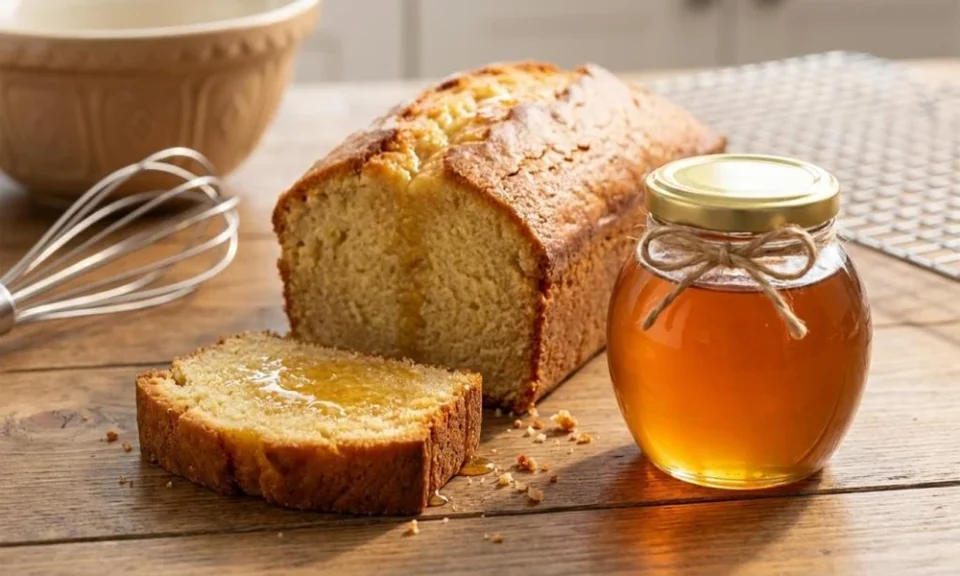
Picture a Sunday morning: banana bread is on the agenda, the oven is preheating, and you reach for the sugar canister only to realize it’s nearly empty. You’ve got a full jar of wildflower honey on the counter. Here’s the thing, that swap is not just a fix for an empty pantry. Done right, baking with wildflower honey instead of sugar produces a more flavorful, more tender loaf than the original recipe would have given you anyway.
But there’s a catch. You can’t do a one-for-one swap and expect clean results. Honey is a liquid, it’s sweeter than sugar by weight, it caramelizes faster, and it carries its own distinct flavor. Ignore those differences and you’ll get a flat, gummy, or overly dark bake. Respect them and wildflower honey becomes one of the most interesting ingredients in your kitchen.
This guide gives you the exact mechanics, the ratios, the adjustments, and the flavor thinking you need to make it work every time.
Why Wildflower Honey Is a Baker’s Best Upgrade
Not all honey behaves the same in the oven. Clover honey is mild and clean. It disappears into white cake batter and lets butter and vanilla lead. Wildflower honey does the opposite. It carries a richer, more complex flavor that stands up to warming spices, nuts, and whole grains. It has a richer, more complex character that pairs well with warming spices and nuts, making it a standout in banana bread, oatmeal cookies, and cornbread.
That complexity comes from the bees themselves. Bees forage within roughly a three-mile radius of their hive, and the dominant nectar plants in that range determine what ends up in the jar. A hive working the Texas Hill Country pulls from dozens of blooming species at once. The honey it produces tastes like that whole landscape in one spoonful.
Then there’s the moisture factor. Honey browns beautifully, giving cakes and breads a deep golden crust, and lends a tender, fine crumb to muffins and quick breads. That’s a direct result of honey’s fructose content and its hygroscopic nature, meaning it holds onto water, which keeps your bakes from drying out after the first day.
“If you want your baked goods to taste like they were made with honey, not just sweetened with it, wildflower is the one.”
This reflects a widely shared view among artisan bakers who note that the multi-floral depth of wildflower varieties contributes distinctly to baked flavor in a way mild single-source honeys simply cannot match.
The SLAB Method: Four Adjustments That Make the Swap Work
Every time you substitute wildflower honey for sugar, you need four adjustments. I call this the SLAB Method: Swap ratio, Liquid reduction, Adjust temperature, Balance acidity. Work through all four steps and you’ll produce a consistent bake. Skip one and something goes wrong.
S: Swap Ratio
Use 3/4 cup of wildflower honey for every 1 cup of granulated sugar the recipe calls for. Honey is sweeter than sugar by volume, so you need less of it. This ratio is the industry standard and holds across nearly every baked good, from cookies to loaf cakes to cornbread. For most baking, substitute honey for sugar at a 3:4 ratio, which means 3/4 cup honey per 1 cup sugar.
L: Liquid Reduction
Honey adds moisture to your batter, and you need to compensate. For every cup of honey you use, reduce the other liquids in the recipe by 2 tablespoons. If a recipe has no other liquids at all (some cookies fall into this category), add 2 tablespoons of extra flour instead. This keeps your batter from turning into soup.
A: Adjust Temperature
Drop your oven by 25 degrees Fahrenheit. Honey caramelizes faster than sugar because its fructose responds to heat at a lower threshold. Honey browns faster than sugar because its fructose caramelizes at a lower temperature. A slightly cooler oven gives your bake time to cook through before the exterior goes from golden to dark.
B: Balance Acidity
Honey is naturally slightly acidic. When it replaces sugar, that acidity can interfere with leavening, particularly baking powder. Add 1/4 teaspoon of baking soda per cup of honey used. The baking soda neutralizes the acid and restores the lift your recipe was designed to produce.
Run all four steps every time, and the swap becomes muscle memory after two or three bakes.
Which Recipes Work Best
Wildflower honey is not the right call for every recipe, and being honest about that saves you from a few disappointing bakes.
| Recipe Type | Works Well With Wildflower Honey? | Why |
|---|---|---|
| Banana bread | Excellent | Bold flavors complement the honey’s earthy depth |
| Oatmeal or spice cookies | Excellent | Spice and nut notes amplify the honey’s complexity |
| Cornbread | Very good | Savory base balances the floral sweetness |
| Whole wheat muffins | Very good | Nutty grain matches the honey’s full body |
| White cake or sugar cookies | Mediocre | Honey flavor competes with delicate vanilla base |
| Meringue or soufflé | No | Liquid content disrupts structure entirely |
The pattern is simple: the bolder the bake, the better wildflower honey performs. Delicate, pale, or egg-white-driven recipes are where you leave the honey jar on the shelf.
Why Texas Wildflower Honey Hits Different
All wildflower honey is multi-floral, but geography shapes flavor in ways that matter in the kitchen. A conservative estimate suggests that over 700 native bee species occur in Texas, according to the Texas Parks and Wildlife Department, and that extraordinary botanical diversity shows up in the honey those colonies produce. Mesquite, bluebonnet, horsemint, and huisache all bloom across different regions and seasons, each one adding a distinct note to the final jar.
The volume of honey production Texas beekeepers achieve reflects just how rich that landscape is. According to USDA reports, in 2019 Texas produced 7,560,000 pounds of honey from 126,000 honey-producing colonies , making the state one of the most productive in the country. The USDA National Agricultural Statistics Service tracks honey bee colonies and production data by state each year, and Texas consistently ranks among the top producers.
For bakers chasing genuine regional character in their food, sourcing locally matters. Raw honey made in Texas comes from hives working those exact landscapes, pulling nectar from the same wildflowers that make Central Texas famous every spring. That’s flavor you can actually taste in your banana bread, not just a marketing claim on the label.
A Quick Practical Checklist Before You Start
- Measure honey by weight if you can. It’s denser than water, and volume measures can run slightly high.
- Spray your measuring cup with a thin coat of oil before pouring honey in. It slides out cleanly every time.
- Store your honey at room temperature. Cold honey thickens and doesn’t blend into batter smoothly.
- If your honey has crystallized, set the jar in a bowl of warm water for 10 minutes. Do not microwave it at high power.
- Start with a recipe you’ve already made successfully with sugar. You’ll notice the difference in texture and color on a familiar baseline.
The Broader Shift Happening in American Kitchens
This kind of swap isn’t niche anymore. According to the USDA Economic Research Service, U.S. consumption of honey and made-with-honey products reached an all-time high of 688.6 million pounds in 2024, with per capita consumption increasing approximately 25% between 2023 and 2024. You can read the full National Honey Board announcement for context on what’s driving that surge. The short version: home bakers and consumers broadly are rethinking refined sugar, and honey is where many of them are landing.
Wildflower varieties are leading that shift because they deliver something processed sugar never will: a connection to a specific place and season. Every jar is slightly different from the last. That’s not inconsistency. That’s terroir, and it makes your baking more interesting.
The mechanics of the swap are simple once you run them a couple of times. The SLAB Method takes 30 seconds to apply to any recipe. After that, the only question is which jar of wildflower honey you’re reaching for.
