
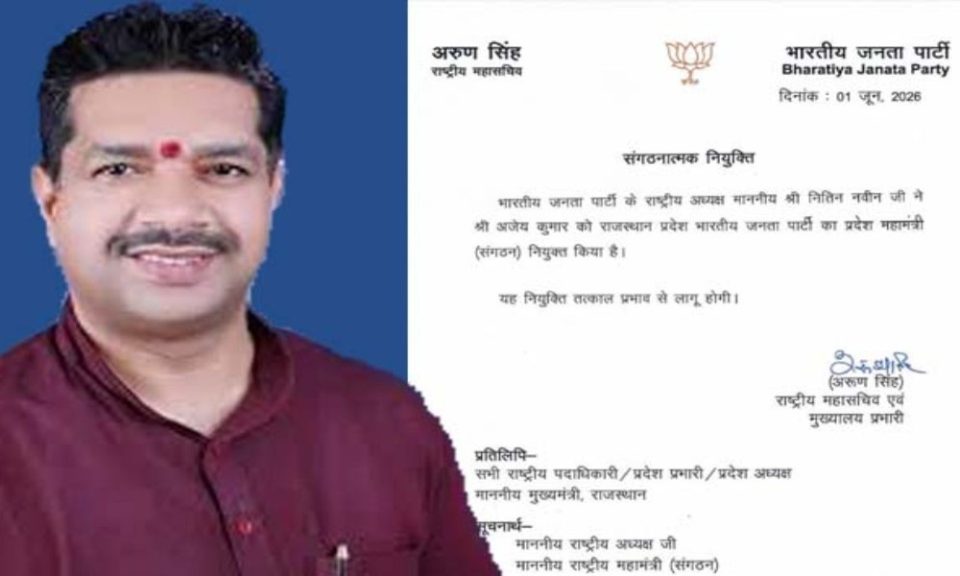
The Bharatiya Janata Party’s central leadership has given Ajaey Kumar BJP the organisational responsibility of Rajasthan, recognising his contribution to the party’s strong performance in Uttarakhand. The decision is being viewed within the BJP as a reward for his successful tenure in the hill state, where the organisation remained disciplined, active and well-coordinated despite leadership changes and political challenges.
Rajasthan is one of the BJP’s most important political states. It has a vast electoral landscape, complex social equations and a highly competitive political environment. Entrusting Ajaey Kumar with such a responsibility indicates that the national leadership sees him as a reliable organisation builder who has already demonstrated his ability in Uttarakhand. The appointment also sends a clear message that leaders who deliver results at the organisational level are trusted with larger roles in the party.
Ajaey Kumar’s tenure in Uttarakhand is considered significant because the party organisation continued to function effectively even during periods of leadership transition. The state witnessed changes at the level of chief minister and state party president, developments that can often disturb the rhythm of a political organisation. Workers may become uncertain, local units may slow down and coordination between the government and the party may weaken. However, the Uttarakhand BJP remained steady and active through these phases.
According to party insiders, one of the main reasons behind this stability was Ajaey Kumar’s emphasis on organisational discipline. He ensured that the party’s functioning was not limited to election campaigns or high-profile political events. Instead, the organisation remained engaged in regular activities throughout the year. Booth-level meetings, training programmes, membership campaigns, public outreach drives and national programmes were implemented in a structured manner. This gave the organisation continuity and kept the cadre connected.
Political observers believe that Ajaey Kumar’s biggest contribution was the strengthening of the organisation from the booth level upward. In modern electoral politics, the booth has become the most important unit of mobilisation. A party may have strong leadership and a powerful narrative, but without an active booth-level structure, it cannot fully convert support into votes. Under Ajaey Kumar’s guidance, the Uttarakhand BJP paid close attention to booth committees, local workers, mandal-level coordination and district-level monitoring.
The geography of Uttarakhand makes this task especially difficult. The state has remote hill regions, border districts, scattered settlements and areas where regular travel is challenging. For any political organisation, maintaining constant contact with workers in such regions requires planning, persistence and regular field visits. Ajaey Kumar is credited with encouraging direct communication with grassroots workers and ensuring that organisational activities reached distant areas as well. This helped the BJP maintain connectivity in places where political outreach often becomes difficult.
Another major achievement of his tenure was the coordination between the government and the organisation. In a ruling party, this coordination is crucial. The government makes decisions and implements schemes, but the organisation carries those messages to the people. At the same time, workers bring local feedback, public sentiment and ground-level concerns back to the leadership. Ajaey Kumar’s role in maintaining this two-way communication is considered important by many within the party.
The central leadership is also believed to have taken note of the fact that the Uttarakhand BJP remained largely away from major organisational controversies. For any party in power, managing expectations is not easy. Workers expect recognition, local leaders seek space and different groups may push their own priorities. Maintaining discipline in such an environment requires a balanced but firm organisational approach. Ajaey Kumar’s tenure is being seen as an example of how internal discipline can be maintained while keeping workers active and motivated.
Uttarakhand BJP’s performance in different elections and national campaigns also strengthened his profile. Party programmes were not treated as mere formal exercises. They were taken to the ground with planning and follow-up. Membership drives, service programmes, public contact campaigns, training sessions and national-level initiatives were carried out with seriousness.
This consistent organisational activity helped create a strong foundation for the party’s political success in the state.
Ajaey Kumar’s appointment to Rajasthan is therefore not being viewed as an isolated decision. It is being seen as national recognition of the organisational system developed in Uttarakhand. The BJP leadership appears to have rewarded a style of working that combines discipline, grassroots contact, government-organisation coordination and consistent execution of programmes. This style is expected to be valuable in Rajasthan, where the scale of political activity is much larger.
Rajasthan, however, will present a bigger challenge. Unlike Uttarakhand, it is a vast state with multiple political regions and diverse social realities. The organisational expectations will be higher and the political pressure will be greater. Ajaey Kumar will have to work with state leaders, district units, booth workers and various wings of the organisation while keeping the party machinery active across the state. His experience in Uttarakhand may provide a strong foundation, but Rajasthan will test his ability on a wider scale.
The appointment also carries a symbolic message for the Uttarakhand unit. It shows that the work done by the state organisation has been noticed at the national level. For party workers in Uttarakhand, Ajaey Kumar’s new responsibility is a matter of pride. It reflects the leadership’s belief that the organisational model developed in the state can be useful in a larger and politically more complex state.
Within the BJP’s internal structure, organisation ministers play a crucial role. They often work away from public attention, but their role is central to keeping the party structure functional.
They coordinate workers, ensure implementation of programmes, maintain communication between different levels of leadership and prepare the organisation for political and electoral challenges. Ajaey Kumar’s rise within this structure underlines the importance the BJP gives to organisational work.
His working style has been described as focused, disciplined and result-oriented. Instead of relying only on public statements or symbolic events, he has focused on building systems that keep workers engaged. This quality appears to have earned him the confidence of the national leadership.
In conclusion, Ajaey Kumar’s appointment as organisational in-charge of Rajasthan is a clear reward for Uttarakhand BJP’s strong performance during his tenure. It recognises his role in strengthening the party structure, maintaining discipline, improving coordination and ensuring success in organisational campaigns. The responsibility ahead is significant, but his record in Uttarakhand has positioned him as one of the BJP’s trusted organisation builders.
